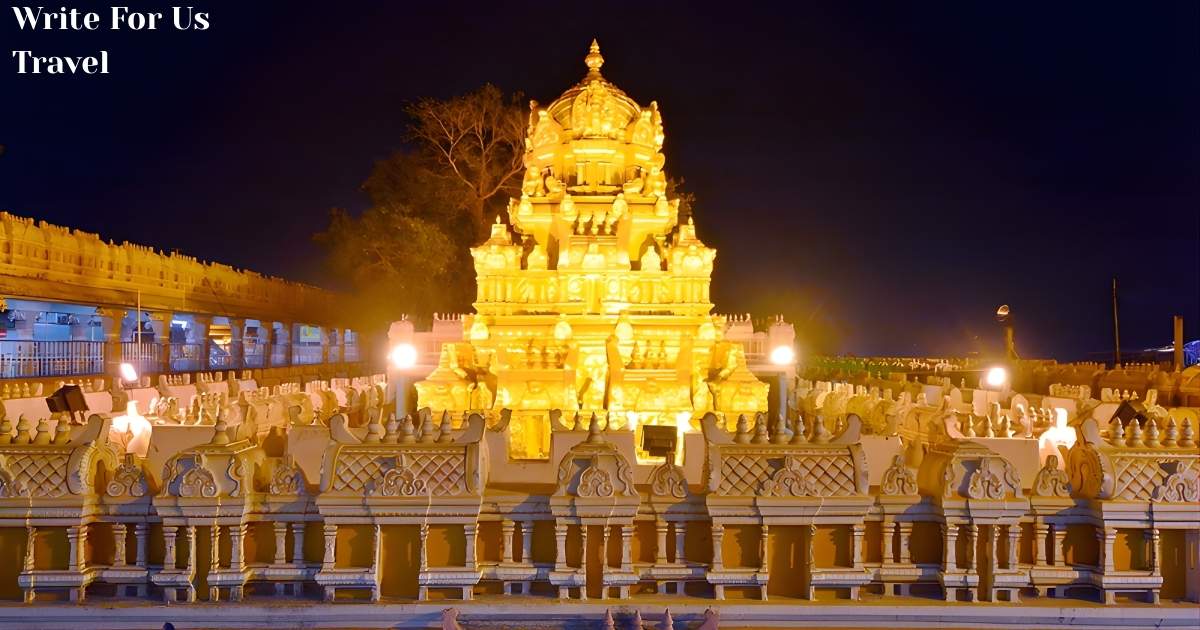
Have you ever stood somewhere and felt a wave of calm wash over you, like the universe just paused for a second? That’s exactly what happens when you set foot on Indrakeeladri Hill in Vijayawada. Nestled on this rocky hilltop above the sacred Krishna River, the Kanaka Durga Temple is not just a place of worship. It’s an experience that stays with you long after you’ve left.
Every year, millions of devotees make the journey to this ancient shrine. Some come seeking blessings. Some come with heavy hearts. And some simply come to feel the presence of something greater than themselves. Whatever brings you here, this temple never disappoints.
So whether you’re planning your first visit or your fifth, here’s everything you need to know, from Kanaka Durga Temple Vijayawada timings to its rich mythology, festivals, architecture, and travel details.
Historical Significance
The story of this temple goes back thousands of years, and it’s one of those stories that gives you goosebumps every time you hear it.
According to ancient Hindu scriptures, the demon Mahishasura terrorized the heavens and the earth. The gods, unable to defeat him, channeled their combined divine energies into creating a supreme goddess. She fought the demon for nine nights and slayed him on the tenth day. That goddess was Durga, and the celebration of her victory is what we now know as Navratri and Vijayadasami.
The presiding deity of this temple, Goddess Kanaka Durga, is believed to be a self-manifested form of that very goddess. Devotees call her Swayambhu, meaning she was not installed by human hands but emerged on her own. That belief alone adds a layer of reverence that you can feel the moment you enter the sanctum.
Historically, the Vijayawada Shakti Peetha temple finds mention in texts like the Skanda Purana and Brahmanda Purana. The temple has been patronized by various dynasties over the centuries, including the Eastern Chalukyas, the Kakatiya rulers, and later the Vijayanagara Empire. Each era added something to the temple’s legacy, whether it was infrastructure, rituals, or inscriptions that still exist today.
The name Vijayawada itself is believed to derive from “Vijaya,” meaning victory, a nod to the goddess’s triumph over evil. Some scholars also connect it to the story of the goddess granting a boon to Arjuna from the Mahabharata on this very hill. Legend says Arjuna performed severe penance at Indrakeeladri to obtain the Pashupatastra weapon from Lord Shiva. The hill has been considered sacred since that moment.
The Sri Durga Malleswara Swamyvarla Devasthanam temple, as it is formally known, has been managed by the Andhra Pradesh government’s endowment board for several decades. This ensures the temple’s traditions, rituals, and infrastructure are maintained with consistency and care.
Read More: Gnana Saraswati Temple, Basara Temple Timings, Info
Architectural Beauty
The Kanaka Durga Temple is a textbook example of Dravidian temple architecture, and yet it feels anything but textbook when you’re standing in front of it.
The towering gopuram, or gateway tower, is the first thing that catches your eye. Adorned with intricate carvings of deities, celestial figures, and mythological scenes, it rises dramatically against the Vijayawada skyline. The detailing on the gopuram is extraordinary. Every inch seems to tell a story.
The sanctum sanctorum houses the idol of Goddess Kanaka Durga in a seated posture, adorned with gold ornaments, flower garlands, and vibrant silk sarees. The goddess is depicted in her benevolent form, a sight that many devotees describe as deeply moving. On special occasions, the deity is dressed in different alankaram styles, each one representing a different form of the goddess.
What makes the architecture even more fascinating is how seamlessly the temple blends into the natural landscape of Indrakeeladri Hill. The rock formations, the hill’s contours, and the Krishna River flowing below all contribute to a setting that feels curated by nature itself.
There’s also the Malleswara Swamy shrine within the complex dedicated to Lord Shiva, which adds another layer to the temple’s spiritual identity. Shiva and Shakti coexisting in the same sacred space is a powerful symbol in Hindu philosophy, and this temple embodies that beautifully.
The corridor connecting the inner and outer shrines is lined with stone pillars that showcase fine craftsmanship. Light filters through in specific ways depending on the time of day, creating an almost theatrical effect inside the mandapam. If you visit during the golden hour, just before sunset, the temple practically glows.
Spiritual Importance
Ask any devotee why Kanaka Durga Temple matters, and you’ll get a different answer every time. That’s the beauty of it.
For many, the answer lies in the fact that this is one of the 18 Maha Shakti Peethas in India. The Shakti Peetha tradition holds that parts of Goddess Sati’s body fell at specific locations across the subcontinent after her death, and each of those spots became a powerful center of divine feminine energy. Vijayawada is believed to be the site where her cheek fell, making this temple extraordinarily significant in the Shakti tradition.
The Sri Chakra worship Vijayawada temple practices are considered especially potent. The Sri Chakra, a geometric yantra representing the divine cosmos, is central to the tantric rituals performed here daily. These are not just symbolic gestures. Priests trained in these traditions conduct elaborate pujas that follow protocols passed down through generations.
The concept of Goddess Kanaka Durga worship goes beyond asking for material gains. Devotees come here to seek inner strength, deliverance from fear, and spiritual liberation. The goddess is seen as both a fierce protector and a compassionate mother, and that duality resonates with people from all walks of life.
What’s also spiritually compelling is the presence of the Krishna River right below the temple. The river is considered sacred in its own right, and many pilgrims take a ritual dip in the river before climbing the hill for darshan. The combination of river purification followed by temple worship creates a deeply layered spiritual journey.
Many saints and spiritual figures throughout history have associated themselves with this temple. Adi Shankaracharya, the great philosopher-monk, is said to have visited the temple and installed the Sri Chakra here, further cementing its place in the spiritual geography of India.
Festivals and Celebrations
If you think a regular day at the temple is impressive, wait until you experience it during Navratri.
Vijayawada Navratri celebrations at the Kanaka Durga Temple are considered among the grandest in all of Andhra Pradesh. For nine nights, the entire city transforms. The streets fill with flowers, music, and the scent of incense. Thousands of devotees pour in from across the country, and the waiting lines can stretch for hours. But ask any pilgrim who has experienced it, and they’ll tell you it’s worth every minute.
During Navratri, the goddess is adorned in a different form each day. Each alankaram has deep mythological significance. On one day she appears as Swarna Kavachalankrita Durga, draped in golden armor. On another, she’s presented as Saraswati, the goddess of wisdom. The transformations are breathtaking, and hundreds of thousands of devotees gather just to witness each one.
Vijayadasami, the tenth day, is the most important of all. It marks the goddess’s ultimate triumph over evil. The entire city erupts in celebration, and the temple conducts special abhishekams and alankarams that draw massive crowds.
Apart from Navratri, the temple celebrates a host of other festivals throughout the year. Ugadi, the Telugu New Year, sees huge gatherings. Karthika Masam, the holy month of Karthik, brings evening lamp-lighting ceremonies that are stunningly beautiful by the riverside. Shivaratri celebrations at the Malleswara Swamy shrine are equally vibrant.
The Durga temple festivals in Andhra Pradesh don’t get much bigger than what happens here. And the energy is infectious. Even if you’re not particularly religious, being part of a crowd that is collectively celebrating something with such joy and devotion is a rare and stirring experience.
Pilgrimage Experience
So what’s it actually like to visit? Let’s walk through it together.
Most pilgrims begin their journey at the banks of the Krishna River. Taking a holy dip here before the climb is a long-standing tradition. The river’s cool waters and the sound of temple bells drifting down from the hill above set the tone perfectly.
The climb to the temple can be done in a few ways. There are steps carved into the hillside, known locally as “metlu,” that devotees use. It’s a physically demanding climb, especially in the summer heat, but many pilgrims see it as an act of devotion in itself. If you’d rather not climb, there are other options available, but more on that in the travel section.
Once you reach the top, the darshan process at Kanaka Durga Temple is organized into different queues based on the type of ticket or seva you’ve booked. There are free darshan options, though they can involve longer waiting times. Paid sevas allow for a more intimate and faster darshan experience.
The pilgrimage experience at Kanaka Durga Temple also includes the prasadam that’s offered after worship. The Kanaka Durga Temple prasadam typically includes laddoos and pulihora, both prepared fresh at the temple kitchen. Many devotees carry this home as a sacred offering to family members who couldn’t make the trip.
The view from the top is nothing short of spectacular. You can see the Prakasam Barrage stretching across the Krishna River, the city spreading out in all directions, and the hills of Kondapalli in the distance. It’s one of those viewpoints near Kanaka Durga Temple that makes you pause and just breathe.
The overall atmosphere is one of collective devotion. People of all ages and backgrounds stand together, wait together, and pray together. There’s a quiet solidarity in that shared experience that’s hard to describe but easy to feel.
Accessibility and Travel
Getting to the temple is easier than you might think, regardless of where you’re coming from.
Vijayawada is extremely well-connected. The city sits on a major railway corridor, and Vijayawada Junction is one of the busiest railway stations in India. Trains from Hyderabad, Chennai, Kolkata, Mumbai, and Delhi all pass through here regularly. If you’re flying, Vijayawada International Airport has flights from most major Indian cities.
Once you’re in the city, the temple is accessible from virtually any point. Autos, cabs, and local buses all run to the base of Indrakeeladri Hill regularly. The Kanaka Durga Temple ropeway facility is a game-changer for those who find the steps challenging. The ropeway offers a cable car ride up the hill that gives you a stunning aerial view of the Krishna River and the surrounding cityscape. It’s especially popular with elderly pilgrims and families with young children.
For those who want to walk up, the steps are well-maintained and lit during early morning and evening hours. Shoe stands are available at the base, as footwear is not permitted inside the temple complex.
If you’re visiting as part of a broader Vijayawada temple travel guide experience, there are several other notable sites nearby. Undavalli Caves, Bhavani Island, and the Prakasam Barrage are all within a short distance. Accommodation options range from budget lodges near the temple to mid-range and premium hotels in the city center.
The best time to visit Kanaka Durga Temple for a comfortable experience is early morning on weekdays. Weekends tend to draw larger crowds. Monsoon months bring cooler weather but can make the hill steps slippery. October and November, right after the monsoons, are arguably the finest time to visit since the surroundings are lush green and the weather is pleasant.
Unique Features of the Temple
What sets this temple apart from the thousands of other temples across India? Quite a lot, actually.
First, the self-manifested nature of the deity is extraordinarily rare. Most temple idols are consecrated through specific rituals. The belief that Goddess Kanaka Durga emerged on her own places this temple in a very select category of spiritually charged sites.
Second, the Sri Chakra installation, attributed to Adi Shankaracharya, makes this one of very few temples in India where Sri Chakra worship has been an unbroken tradition for centuries. The daily rituals performed here are deeply rooted in Agamic traditions and represent a living heritage.
Third, the view from Indrakeeladri Hill is unmatched. The combination of a hilltop temple, a sacred river directly below, and a modern city surrounding it creates a visual and spiritual contrast that’s deeply compelling. The Krishna River spiritual sites don’t offer a more dramatic setting than this one.
Fourth, the scale of celebrations here is genuinely staggering. During Navratri, the temple draws upward of a million devotees over the nine-day period. The logistical effort involved in managing that many people while maintaining the sanctity and cleanliness of the temple is impressive.
Fifth, the temple has consistently adapted to the needs of modern pilgrims without compromising its traditional core. Online booking for sevas, the ropeway, improved facilities for differently-abled visitors, and digital queuing systems all reflect a thoughtful approach to temple management.
This balance between ancient tradition and modern accessibility is what makes the Kanaka Durga Temple one of the Andhra Pradesh famous temples that keeps drawing people back, not just once but again and again.
FAQ’s
What are the Kanaka Durga Temple Vijayawada timings for darshan?
The temple generally opens at 5:00 AM and closes around 9:00 PM, with a midday break between 1:00 PM and 3:00 PM. Timings may vary during festivals and special occasions.
Is Kanaka Durga Temple a Shakti Peetha?
Yes, it is widely regarded as one of the 18 Maha Shakti Peethas, believed to be the site where Goddess Sati’s cheek fell, making it one of the most sacred Shakti worship centers in India.
How can I reach the Kanaka Durga Temple at the top of Indrakeeladri Hill?
You can either climb the stone steps or take the ropeway facility, which offers a cable car ride to the hilltop and is suitable for elderly pilgrims and families.
What prasadam is offered at the Kanaka Durga Temple?
The temple typically offers laddoos and pulihora as prasadam, both freshly prepared at the temple kitchen and distributed to devotees after worship.
What is the best time to visit Kanaka Durga Temple for a peaceful experience?
Early weekday mornings are the quietest. October and November offer the most comfortable weather, though Navratri in September or October is the most spiritually vibrant time to visit.

Oliver Bennett is Researcher focused on responsible, experience-led exploration. Having independently planned and completed 40+ trips across Europe and Asia, he provides practical itineraries, transport guidance, and safety insights grounded in firsthand knowledge. His work is supported by verified sources, local expert interviews, and regularly updated travel regulations.