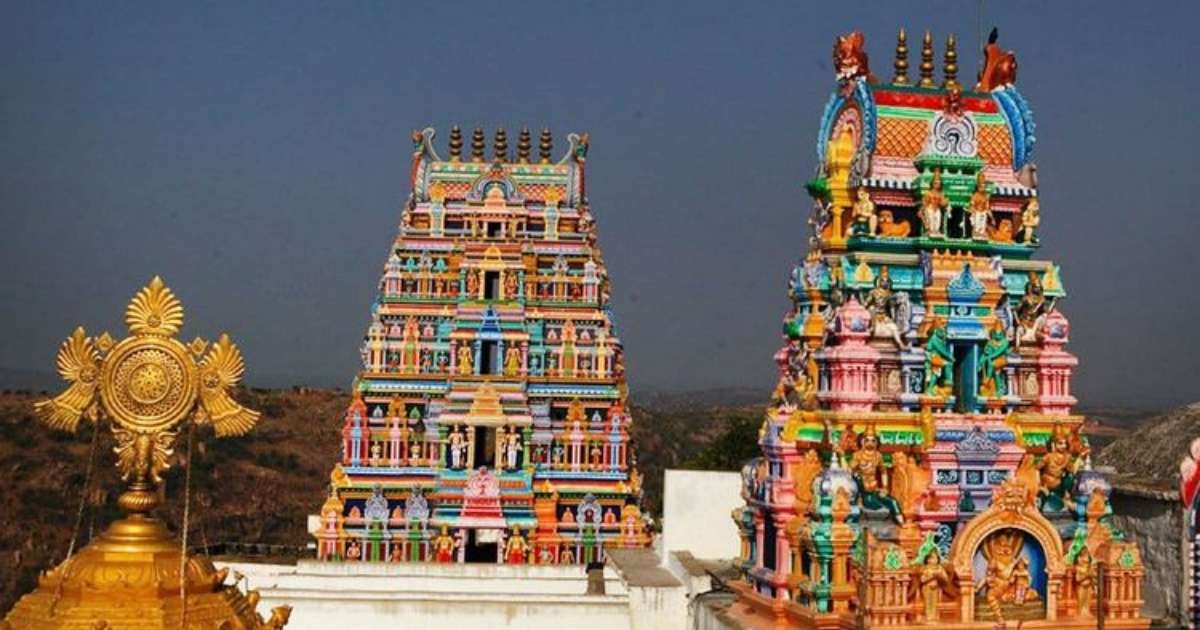
Perched majestically on a hillock in Telangana, Yadagirigutta Temple, also known as Sri Lakshmi Narasimha Swamy Temple, is one of South India’s most sacred shrines dedicated to Lord Narasimha, the fierce yet benevolent fourth incarnation of Lord Vishnu.
Situated approximately 60 kilometers from Hyderabad in the Yadadri Bhuvanagiri district, the temple is a shining beacon of devotion, spirituality, and timeless architectural brilliance. Every year, it attracts millions of pilgrims seeking the Lord’s blessings for courage, prosperity, and protection from negative forces.
Overview of Sri Lakshmi Narasimha Swamy Temple
Perched atop a rocky granite hill in Telangana, the Sri Lakshmi Narasimha Swamy Temple at Yadagirigutta is one of India’s most venerated Vaishnavite pilgrimage sites. It’s not just a temple. It’s a living spiritual experience that has drawn millions of devotees for centuries.
The presiding deity here is Lord Narasimha Swamy, the fierce lion-faced incarnation of Lord Vishnu, who is believed to be swayambhu, meaning self-manifested. That alone gives this shrine a rare and extraordinary sanctity. Unlike temples where idols are installed by human hands, the divine forms here emerged naturally from the rock itself. That’s what makes the sacred cave shrine at Yadagirigutta unlike almost anywhere else you’ll visit in southern India.
The temple is part of the Pancha Narasimha Kshetram, a cluster of five sacred temples in Telangana dedicated to different forms of Narasimha. Yadagirigutta holds the crown position among them. After an extensive renovation project that began in 2016 and was completed with grand fanfare, the temple today stands as a stunning monument blending traditional Dravidian temple architecture with modern craftsmanship. The gold-plated vimana gleams under the Telangana sun, visible for miles around.
More than just a religious site, this is a place where devotional chanting fills the air from before sunrise. Where the scent of fresh flowers and camphor mingles on the breeze. Where ordinary people arrive carrying burdens and leave feeling lighter.
Read More: Arunachalesvara Temple (Annamalaiyar), Tiruvannamalai
Location and How to Reach Yadagirigutta Temple
The temple sits in Yadadri Bhuvanagiri district, about 60 kilometers east of Hyderabad. It’s genuinely one of the most accessible pilgrimage destinations in Telangana. You don’t need to plan an elaborate expedition to get here, it’s a comfortable day trip from Hyderabad for most people.
By road, the temple ghat road access is smooth and well-maintained. You can drive directly or take one of the frequent TSRTC buses from Hyderabad’s Jubilee Bus Station. The journey takes roughly 1.5 to 2 hours depending on traffic. If you’re coming from the other direction, buses from Nalgonda also connect regularly.
By train, Raigiri railway station near the temple is the closest halt. It sits about 10 kilometers away, and from there autos and cabs are readily available. If you’re coming from Secunderabad or Hyderabad, trains on the Kazipet line pass through Raigiri. Check the schedule in advance since not all trains stop here.
If you’re driving yourself, follow the NH-163 from Hyderabad toward Bhongir and then take the turnoff for Yadagirigutta. Parking facilities near the temple complex have improved significantly after the renovation. Still, if you’re visiting during a major festival like Brahmotsavam, arrive well before dawn, parking fills fast.
Mythological Significance and Legends
Every stone on this hill has a story. The mythological significance of Yadagirigutta stretches back to a time long before recorded history, at least according to the scriptures and oral traditions that have been passed down through generations.
The legend begins with an ancient sage named Yadarishi. He was a devoted ascetic who meditated on this very hill with singular focus, seeking a vision of Lord Vishnu. Moved by the intensity of his devotion, Lord Vishnu himself appeared, not in one form but in five. These five manifestations became the Pancha Narasimha forms now enshrined in the sacred cave shrine of the temple. The hill itself takes its name from this sage: Yada + rishi = Yadagirigutta.
According to another widely revered legend, a group of hunters once accidentally struck the hill while digging and blood flowed from the rock. The elders of the region interpreted this as a divine sign, proof that a living deity resided within the stone. This belief in the self-manifested idol continues to be the cornerstone of the temple’s spiritual power.
There’s also a fascinating connection to Lord Vishnu incarnations in the broader Puranic tradition. Narasimha, the half-lion, half-human form, appeared to protect his devotee Prahlada from the demon Hiranyakashipu. That story of ferocious divine protection resonates deeply with every pilgrim who climbs this hill. People come here not just for blessings, but for protection. For relief from fear. For the particular grace that only Narasimha Swamy is believed to bestow.
The Gandabherunda Narasimha lamp, a unique ritualistic lamp in the form of a mythical two-headed bird, is among the most extraordinary artifacts at the temple. It speaks to the depth of local tradition and the layers of devotion accumulated here over centuries.
History and Evolution of the Temple
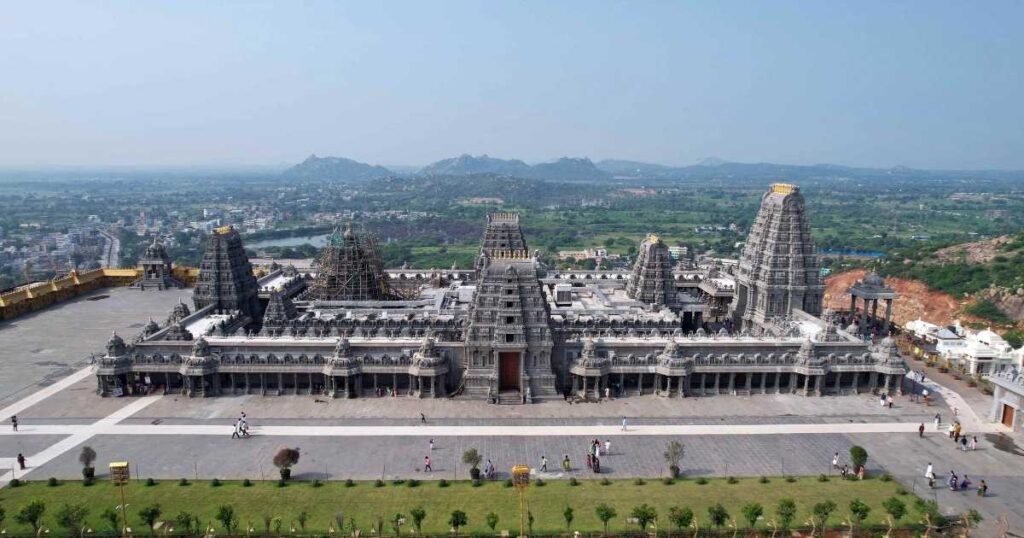
The history of Yadagirigutta temple is long, layered, and genuinely fascinating. Ancient inscriptions and copper plates suggest that worship at this site dates back at least to the Kakatiya period, if not earlier. The Kakatiya style carvings visible in certain sections of the older temple structure hint at a rich medieval past. Kings and chieftains of the region patronized the shrine, and the temple gradually grew from a modest cave sanctuary into a significant religious complex.
For centuries, though, the main shrine remained relatively simple, accessible, but lacking the grandeur it deserved. Pilgrims often had to manage without basic facilities, making the climb and darshan experience challenging.
Everything changed in 2016. The Telangana state government, in collaboration with the temple trust, launched a landmark temple renovation project under the guidance of spiritual leaders and heritage architects. The scale was extraordinary. Artisans trained in traditional stone-carving techniques were brought in from across the country. The modern stone-locking technique used in the reconstruction ensured structural integrity without compromising the authenticity of the Dravidian style.
By 2023, the revamped temple complex had been consecrated with grand Kumbhabhishekam ceremonies. What pilgrims see today is the result of years of painstaking effort. The garbhagriha sanctum has been preserved in its original cave form while the surrounding mandapams for rituals, the queue management complex, the temple gardens, and the approach pathways have all been rebuilt to world-class standards.
The gold-plated vimana rising above the main sanctum is now one of the most recognizable landmarks in Telangana. It’s a proud symbol, not just of religious devotion, but of a state’s commitment to honoring its spiritual places.
Architectural Style and Features
Walk through the newly renovated temple and you’ll notice something immediately: this isn’t just beautiful construction, it’s intentional storytelling in stone. Every column, every frieze, every archway carries meaning.
The architecture follows classical Dravidian temple architecture principles, towering gopurams, carved pillars, structured mandapams, and a clearly defined sanctum. The influence of Kakatiya style carvings is visible in the intricate panel work depicting scenes from the Puranas. These aren’t decorations. They’re scriptures carved in stone for people who couldn’t read.
The main temple sits within a natural cave in the hillside. That original Krishna Shila stone structure has been retained and incorporated into the new design. Standing inside the cave and looking up at the self-manifested idol feels entirely different from visiting a conventional temple. The raw rock ceiling above you, the narrow walls, the ancient energy of the space, it creates a kind of stillness that’s hard to describe.
Outside the cave shrine, the new construction opens up into broad mandapams where large groups of pilgrims can gather for darshan and rituals. The queue management complex is well-organized, with separate lanes for general darshan, VIP darshan entry, and specially-abled pilgrims. Drinking water, rest areas, and clean washrooms are now available throughout the complex.
The temple grounds also feature beautifully maintained temple gardens, fountains, and illuminated walkways that make evening visits particularly atmospheric. Temple illumination after sunset turns the entire hilltop into something out of a dream, golden light bouncing off carved stone while devotional chanting echoes across the valley.
Pancha Narasimha: The Five Divine Forms
This is one of the most distinctive features of Yadagirigutta, and one that even regular visitors sometimes don’t fully appreciate. The temple doesn’t house just one form of Narasimha. It houses five.
Each of the five forms carries its own energy, its own mythological context, and its own significance for devotees.
Jwala Narasimha is the fierce, fiery form, depicted in a blazing posture symbolizing the destruction of evil. Devotees who seek protection from enemies or negative forces especially revere this form. The Jwala Narasimha fiery idol radiates an intensity that’s palpable even for first-time visitors.
Ugra Narasimha is the wrathful, powerful form housed in a cave section of the temple. The Ugra Narasimha cave form is perhaps the most awe-inspiring of the five, raw, unadorned, and tremendously powerful in presence.
Yoga Narasimha represents the meditative aspect of the deity. Meditation at Yoga Narasimha is considered especially potent for those seeking mental peace, clarity, and liberation from worldly attachments.
Lakshmi Narasimha is the benevolent, grace-bestowing form, flanked by Goddess Lakshmi, this is the form most associated with prosperity, family well-being, and divine blessings.
Chatravata Narasimha is the fifth form, seated under a sacred fig tree, representing shelter and protection for all living beings.
Together, these five forms create a complete spiritual experience. Visiting all five in a single darshan is considered deeply auspicious. Most pilgrims make it a point to seek blessings from each form during their visit.
Daily Rituals and Worship Schedule
The rhythm of daily life at Yadagirigutta temple is set by a precise schedule of rituals that begins before dawn and ends well past nightfall. If you’ve never experienced temple rituals up close, this place will give you a masterclass.
The day opens with Suprabhata Seva, a devotional awakening service where priests recite sacred hymns to rouse the deity from divine slumber. It’s an intimate ritual, soft and reverent, and attending it in the early morning hours when the temple is quiet feels genuinely special.
Abhishekam ceremony follows, a ceremonial bathing of the idol with sanctified water, milk, honey, turmeric, and other sacred substances. The Abhishekam is performed multiple times through the day at designated hours.
Naivedyam offerings, the formal presentation of food to the deity, are made at regular intervals throughout the day. The kitchen at the temple prepares traditional offerings, and the prasadam distributed afterward is considered highly sacred.
Satyanarayana Vratham, Kalyanotsavam ritual, and Sudarshana Homam are among the special poojas that devotees can book in advance for specific wishes or occasions. Traditional poojas of various kinds can be arranged through the temple’s online booking system.
The day closes with Ekanta Seva, a prayer ritual signifying the deity’s retirement for the night. It’s the mirror of Suprabhata, and attending it at the end of a long day of pilgrimage feels like a natural, satisfying conclusion.
Temple Timings and Darshan Hours
Planning your visit around the correct timings makes a huge difference. Here’s everything you need to know about Yadagirigutta Temple Timings so you don’t end up waiting unnecessarily or missing darshan.
The temple generally opens at 4:00 AM for the Suprabhata Seva and closes around 9:00 PM after the Ekanta Seva. However, these temple opening hours and temple closing hours can shift slightly during festival seasons, so always verify on the official TTD Yadagirigutta website before you travel.
| Time Slot | Activity |
| 4:00 AM – 5:00 AM | Suprabhata Seva (early morning darshan) |
| 5:00 AM – 12:00 PM | General Darshan |
| 12:00 PM – 1:00 PM | Noon rituals and brief closure |
| 1:00 PM – 5:00 PM | Afternoon Darshan |
| 5:00 PM – 8:30 PM | Evening darshan and Aarti |
| 8:30 PM – 9:00 PM | Ekanta Seva and temple closure |
For early morning darshan, arriving by 3:30 AM on weekdays is advisable. Weekends and festival days draw massive crowds. On those days, queue waiting times can extend to 4–6 hours for general darshan.
VIP darshan entry is available for a fee and significantly reduces wait time. Tickets can be booked online through the official temple portal. For those with mobility challenges, accessible darshan arrangements are in place.
Regarding dress code, traditional attire is expected and respected here. Women are encouraged to wear a saree or salwar kameez. Men in dhoti are welcomed with particular warmth, though clean, modest clothing is accepted. The temple management takes the traditional attire dress code seriously, especially for VIP darshan queues.
Major Festivals Celebrated at Yadagirigutta
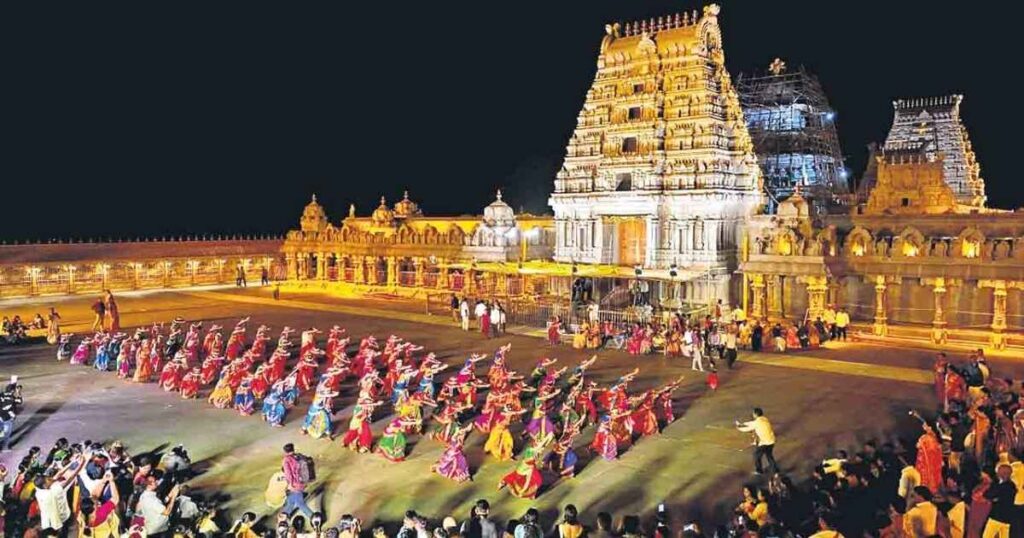
If you want to experience Yadagirigutta at its most vibrant and alive, time your visit around one of the major festivals. The energy during these celebrations is extraordinary.
Brahmotsavam celebrations are the grandest of all. Held annually over multiple days, this festival involves elaborate processions, rathotsavam (chariot festival), floral decorations, temple illumination, and large-scale devotional programs. Hundreds of thousands of pilgrims converge on the hill during Brahmotsavam. It’s spectacular, deeply moving, and slightly overwhelming in the best way.
Narasimha Jayanti festival marks the appearance day of Lord Narasimha. It falls on the Chaturdashi tithi of the Shukla Paksha in the month of Vaishakha. The celebrations begin well before sunrise and continue all day. Special abhishekams, homams, and cultural programs are organized. This is arguably the most spiritually significant day in the temple’s calendar.
Vaikuntha Ekadashi observance draws enormous crowds in the month of Dhanurmasa (December–January). It’s believed that the gates of Vaikunta, Lord Vishnu’s divine abode, open on this day. Pilgrims from across Telangana and neighboring states arrive overnight to pass through the Vaikunta Dwaram at the temple, seeking moksha.
Dhanurmasam rituals span the entire month of Dhanurmasa. Every morning during this period, special early morning services are conducted before sunrise. Devotees make it a point to visit at least once during Dhanurmasam.
Annakutothsavam celebration, held the day after Diwali, involves the preparation and offering of enormous quantities of food to the deity, symbolizing abundance and gratitude. The prasadam distributed on this day is considered especially auspicious.
Special Poojas and Ceremonies
Beyond the daily routine and annual festivals, Yadagirigutta offers a wide range of special poojas that devotees can participate in. These ceremonies are meaningful ways to mark life events, seek divine intervention, or simply deepen your spiritual connection.
Kalyanotsavam ritual is one of the most beloved. It recreates the celestial wedding of Lord Narasimha with Goddess Lakshmi. Many devotees book Kalyanotsavam to seek blessings for their own marriages or the well-being of their families. It’s a joyful, beautifully orchestrated ceremony involving elaborate decoration of the deities, chanting, and music.
Sudarshana Homam is a powerful fire ritual dedicated to Sudarshana Chakra, the divine discus of Lord Vishnu. It’s performed to remove obstacles, counter negative energies, and invoke divine protection. Many families book this homam during difficult periods.
Satyanarayana Vratham is one of the most commonly performed rituals at the temple, suitable for any auspicious occasion, housewarming, birthdays, anniversaries, or simply as an expression of gratitude. The ritual involves a priest narrating the Satyanarayan Katha while the devotee performs the associated poojas.
Abhishekam ceremony can also be booked privately, either for specific forms of Narasimha or for the main deity. Participating in an abhishekam, even watching one, is a profoundly calming experience.
All special poojas can be booked through the official online portal. Slots fill quickly during festival seasons, so booking at least two to three weeks in advance is strongly recommended.
Accommodation and Facilities for Pilgrims
You don’t need to worry about finding a place to stay. Yadagirigutta has developed a solid infrastructure for pilgrims, especially after the temple renovation.
Yogananda Nilayam accommodation is the temple trust’s own guest house facility. It offers clean, comfortable rooms at reasonable rates, primarily intended for pilgrims. The location is convenient, close to the temple complex, making it ideal for those who want to attend early morning darshan without worrying about transport. Booking in advance through the official portal is essential, particularly for weekends and festivals.
Beyond the trust’s property, several private hotels and lodges have come up around the temple town. Options range from budget dharamshalas to mid-range hotels. Most are within a short walking distance or a quick auto ride from the main temple entrance.
Facilities within the temple complex itself have improved dramatically. The queue management complex includes seating areas, drinking water stations, and clean restrooms throughout. A cloakroom facility is available for storing footwear and personal belongings. Medical assistance posts are stationed at key points for emergencies.
Prasadam counters distribute the temple’s blessed food at nominal cost. There’s also a large food court near the complex where pilgrims can get simple, affordable meals. Annadanam (free meal service) is available on certain festival days.
For senior citizens, families with young children, and devotees with disabilities, special assistance counters are available near the main entrance. The temple administration has made notable efforts to ensure that pilgrimage at Yadagirigutta is genuinely accessible to everyone.
Nearby Tourist Attractions and Points of Interest
Yadagirigutta doesn’t need to be a standalone visit. The surrounding area has quite a few interesting spots worth exploring, especially if you’re traveling with family or staying overnight.
Pallagattu waterfalls tourism is a local favorite. Located a short drive from the temple, these falls are particularly impressive during and just after the monsoon season. The surrounding forest is peaceful and offers a refreshing contrast to the busy temple complex.
Peddamma Thalli Temple nearby is another significant shrine that devotees often combine with their Yadagirigutta visit. Dedicated to the local goddess Peddamma, it holds deep importance for communities in the region.
Bhongir Fort, roughly 30 kilometers away, is one of Telangana’s most dramatic historical landmarks. This monolithic rock fort rises sharply from the plains and offers panoramic views from its summit. History enthusiasts will find it absolutely worth the detour.
Nalgonda town, the district headquarters of the older Nalgonda district, is accessible from Yadagirigutta and has its own cluster of historical sites and temples. If you’re making a longer trip out of the pilgrimage, Nalgonda rounds it out nicely.
Choutuppal, located along the highway, has become a popular food stop for travelers between Hyderabad and Yadagirigutta. Several well-known dhabas and highway restaurants here serve excellent Andhra and Telangana cuisine.
Hotels Near Yadagirigutta Temple
Finding a good place to stay near the temple is easier now than it’s ever been. The growth of the temple town following the renovation has brought in more accommodation options at various price points.
For budget travelers, several small lodges and dharamshalas in the temple town offer basic but clean rooms at around ₹300–₹700 per night. These are simple, no-frills stays but perfectly functional for a devotee who’s spending most of the time at the temple anyway.
Mid-range travelers will find decent hotels in the ₹1,000–₹2,500 range. Most include basic amenities, in-house dining, and reliable Wi-Fi. Some of the better-reviewed options are just 1–2 kilometers from the main temple entrance.
Yogananda Nilayam, operated by the temple trust, remains the top recommendation for pilgrims who prioritize proximity and ease. Rooms here are modest but clean, and the staff is accustomed to managing the needs of devotees on tight schedules.
If you prefer more comfort and are willing to commute, Hyderabad (60 km away) offers a full range of hotels from budget to luxury. Bhongir town (about 20 km away) also has a handful of decent mid-range options that make for a good base.
Booking well in advance is non-negotiable during major festivals. Rooms disappear fast during Brahmotsavam and Narasimha Jayanti. Even for a regular weekend visit, booking two to three days ahead is a good habit.
FAQ’s
What are the temple opening and closing hours at Yadagirigutta?
The temple generally opens at 4:00 AM for the Suprabhata Seva and closes around 9:00 PM after the Ekanta Seva, though timings may shift slightly during festivals.
Is there a dress code for entry into Yadagirigutta Temple?
Yes, traditional attire is encouraged. Women should wear a saree or salwar kameez, and men are welcomed in dhoti or clean modest clothing.
How can I book special poojas at Yadagirigutta Temple?
Special poojas like Kalyanotsavam, Sudarshana Homam, and Abhishekam can be booked through the official temple online portal, ideally two to three weeks in advance.
What is the best time to visit Yadagirigutta Temple to avoid crowds?
Weekday visits in the early morning hours (around 4:00 AM – 6:00 AM) are typically the least crowded. Avoid major festival dates unless you’re prepared for large queues.
How far is Yadagirigutta Temple from Hyderabad, and how do I get there?
The temple is approximately 60 kilometers from Hyderabad. You can reach it by road via NH-163, by TSRTC bus from Jubilee Bus Station, or by train to Raigiri station followed by a short cab or auto ride.

Oliver Bennett is Researcher focused on responsible, experience-led exploration. Having independently planned and completed 40+ trips across Europe and Asia, he provides practical itineraries, transport guidance, and safety insights grounded in firsthand knowledge. His work is supported by verified sources, local expert interviews, and regularly updated travel regulations.